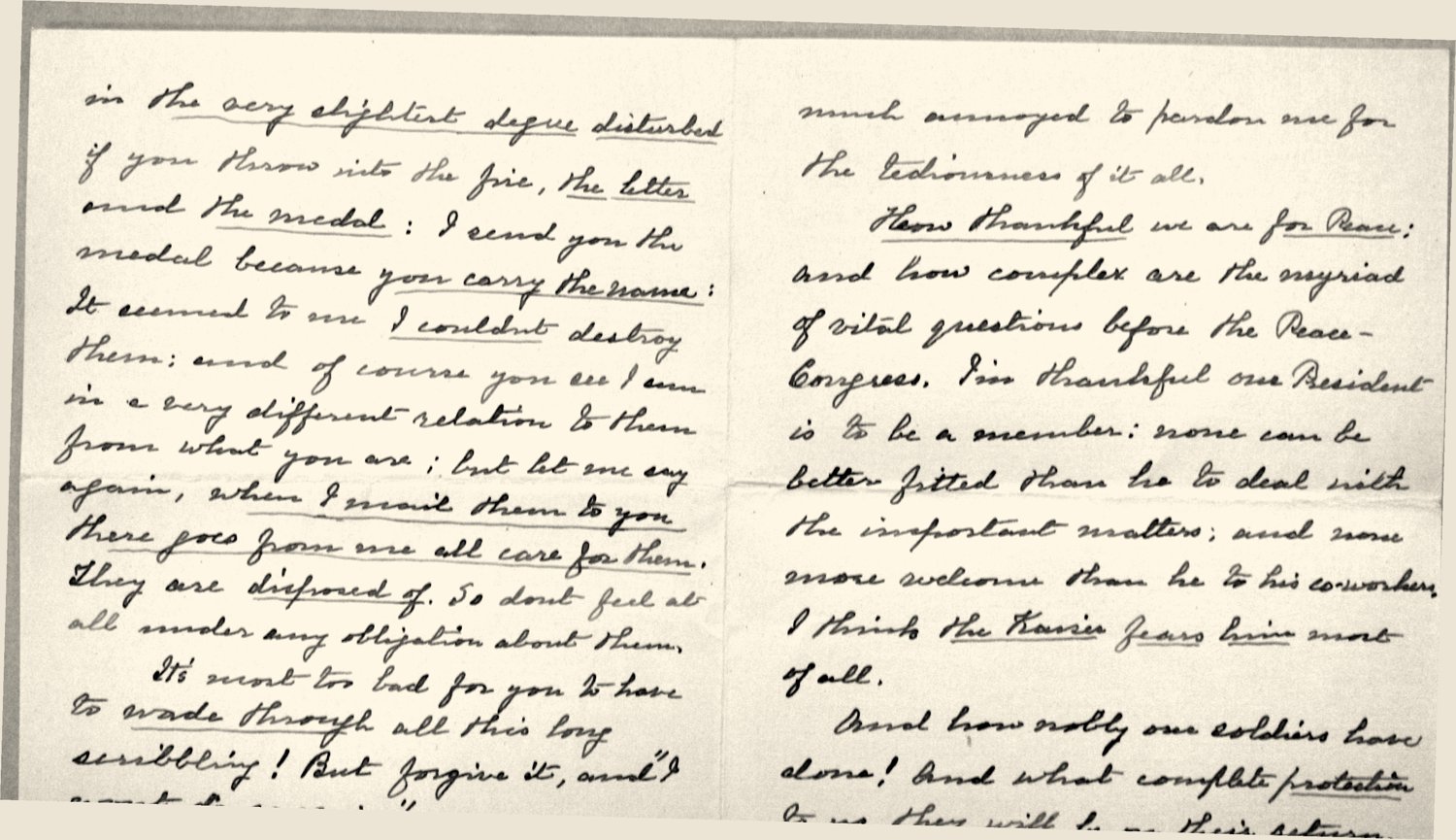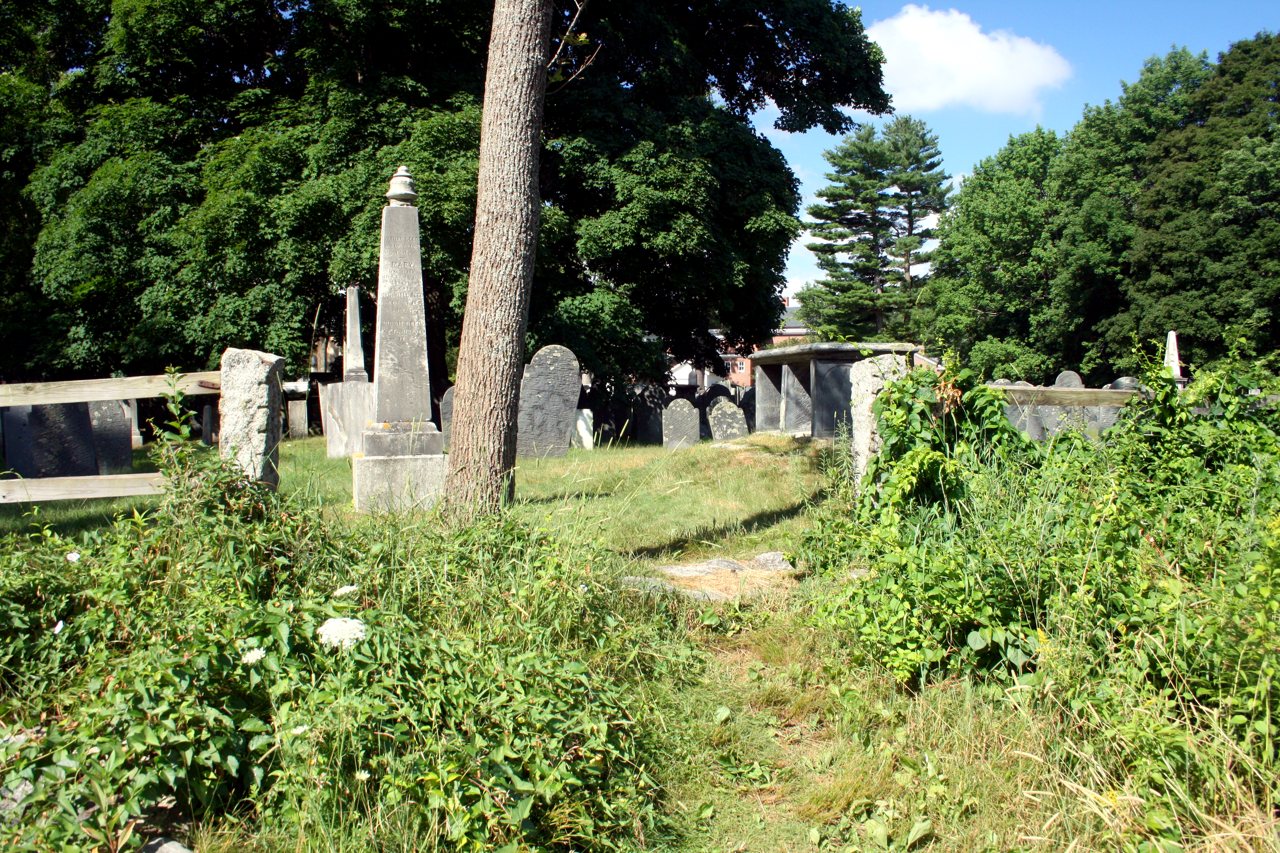
In July 2010, Jon and his wife Kathleen drove north to Massachusetts, following a trail his grandfather had left, and spent two days in Boston, Lexington and Woburn: in the reading room of the New England Historic Genealogical Society and out among the ancestral graves. They photographed much of what they found: Tidd headstones back to 1696, the Tidd Home, a street that still carries the name, and the family papers, three centuries deep, on which this whole history rests.
None of this would exist without Joy Thomas Tidd. Beginning around 1950, armed with sharp pencils and a box of 3×5 index cards, the grandfather of the family chased the Tidd line back through the centuries; it was in that first burst of research that he found the white church in Lexington, Massachusetts, near where the oldest family graves stood. He wrote the genealogy up decades later, in the mid-1990s, and his original index cards are now held at the New England Historic Genealogical Society in Boston. On a family vacation to Lexington in 1969, his son John Thomas Tidd took a faded polaroid of that same church.
Years later Joy's grandson Jon (Jonathan Thomas Tidd) set out to find it. With little more than that 1969 polaroid, he and his wife Kathleen scrubbed through Google Maps Street View until a building matched: First Parish in Lexington, the Unitarian Universalist meetinghouse at 7 Harrington Road, its cornerstone reading "First Congregational (Unitarian) Society, this church was built A.D. 1847."
On July 9–10, 2010, they drove there. Beside the church, on the old Lexington common, the Old Burying Ground held exactly the Tidd headstones the polaroid had promised. From there the trip ran to Boston, and the reading room of the New England Historic Genealogical Society, and out to Woburn, the town the first John Tidd helped found, where the Tidd Home still stands.
Everything on this page came out of those two days, and out of one grandfather who wouldn't let the family forget where it came from.
In the Old Burying Ground beside First Parish in Lexington, the family's slate headstones still stand, three centuries old, some carved before the word "American" meant anything. The old spelling wanders between Tidd, Teed and Tydd from one stone to the next. These are only a few of the Tidd stones here; many more were never photographed, and one of the finest is quoted in Grandpa Joy's own obituary.
Read together with the Dawes-Gates genealogy, the Lexington stones line up into an actual family tree. Tap any stone to read it up close.
Solved in 2026: Hudson’s town genealogy ties the stones together. Joseph (d. 1730) is the son of John Tidd Senʳ and the direct third generation of the line; Daniel was his younger brother. The whole chain is walked out on The Line.
Right where Sgt. John Tidd helped found the town in 1640, the family name is still on the map of Woburn, Massachusetts, on a house and on a street sign.
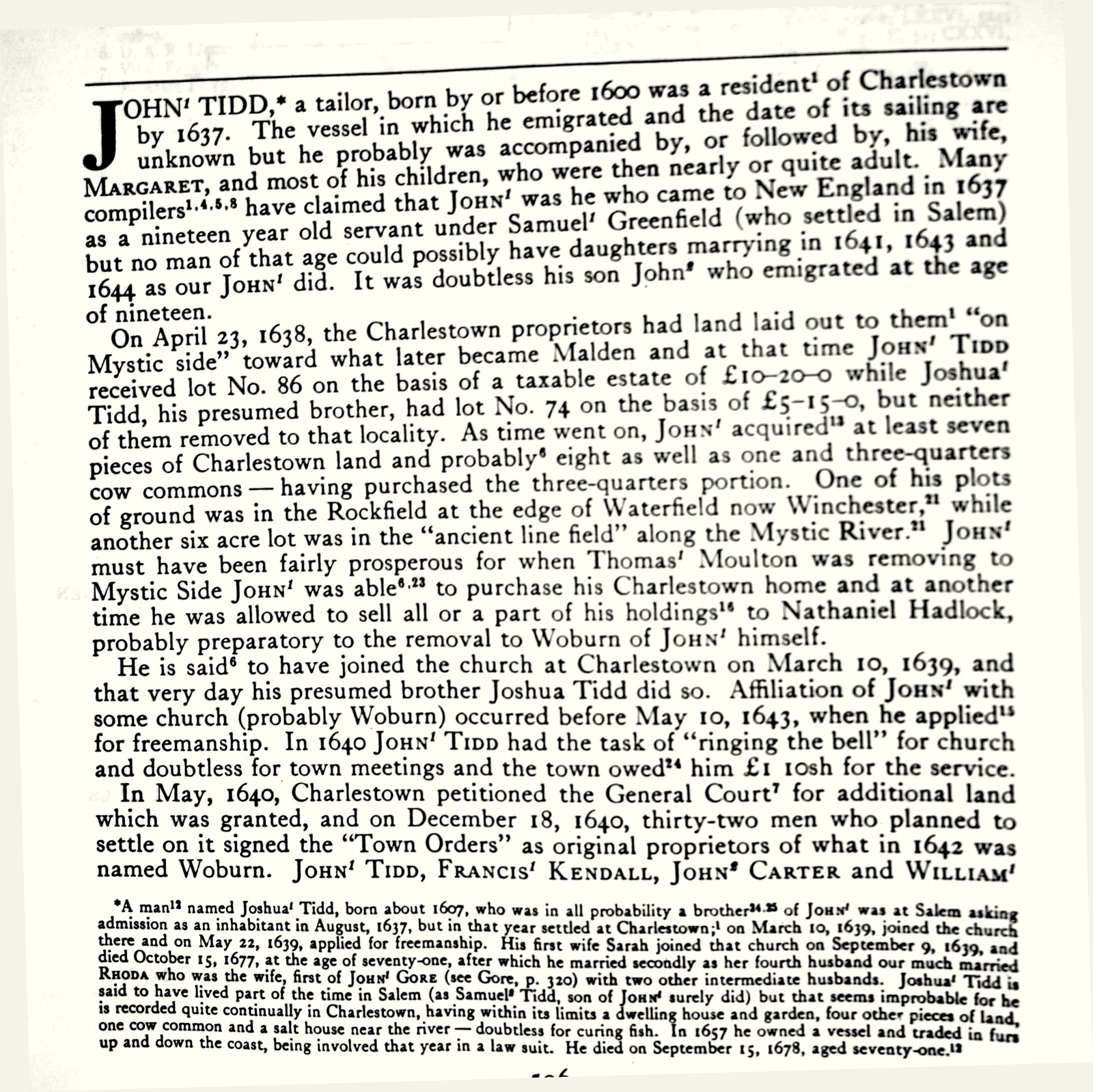
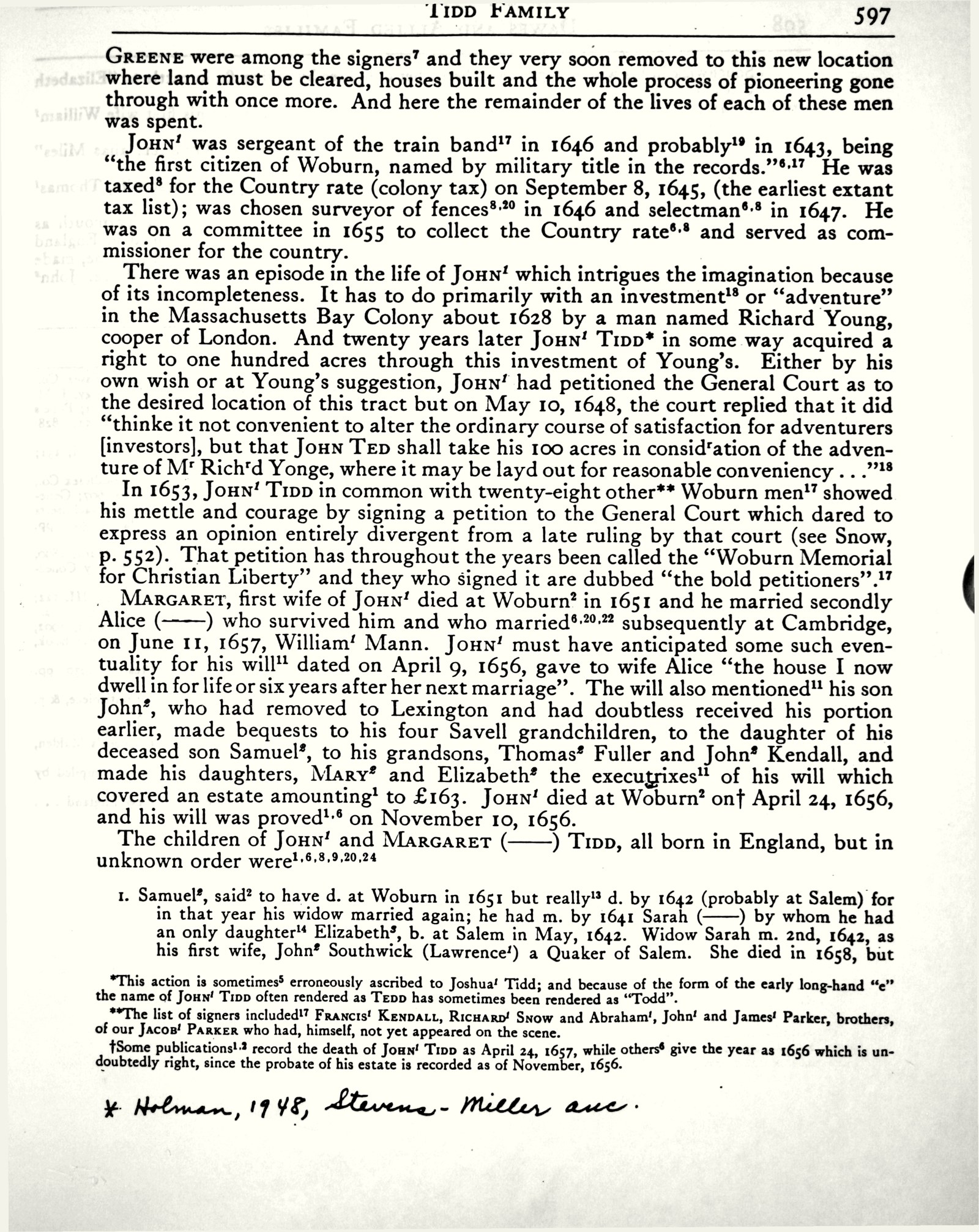
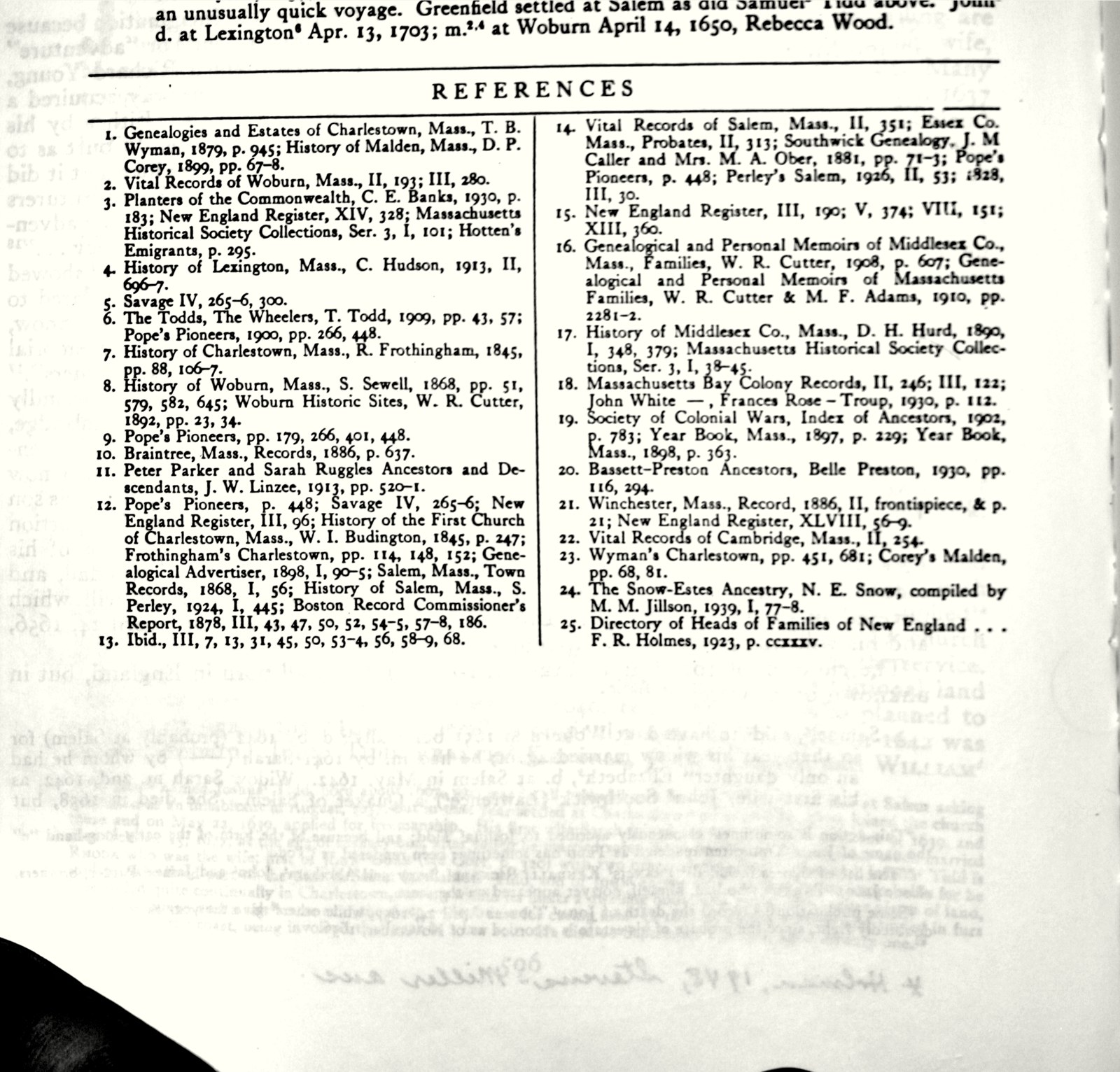
Founded in 1845, the New England Historic Genealogical Society in Boston is the oldest genealogical society in America. Days there produced most of the hard facts behind this whole site, including a published sketch of the immigrant John Tidd, and a family tree drawn generations deep.
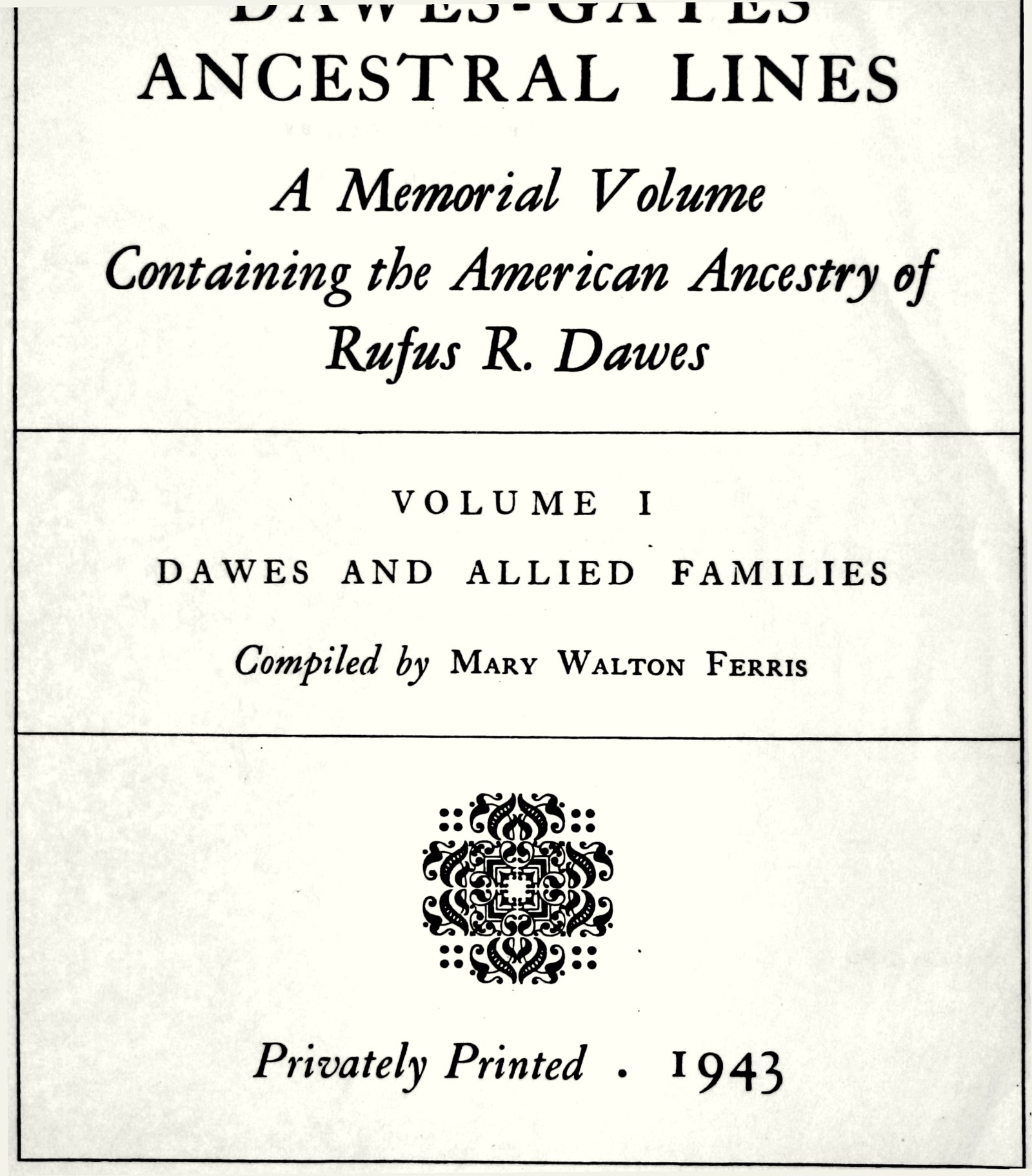
The four pages that anchor this whole family history: the title page of Dawes-Gates Ancestral Lines (Mary Walton Ferris, 1943) and its full "TIDD" chapter. Cleaned and flattened from the originals. Turn the pages, or tap Read the text for a large-print transcription.
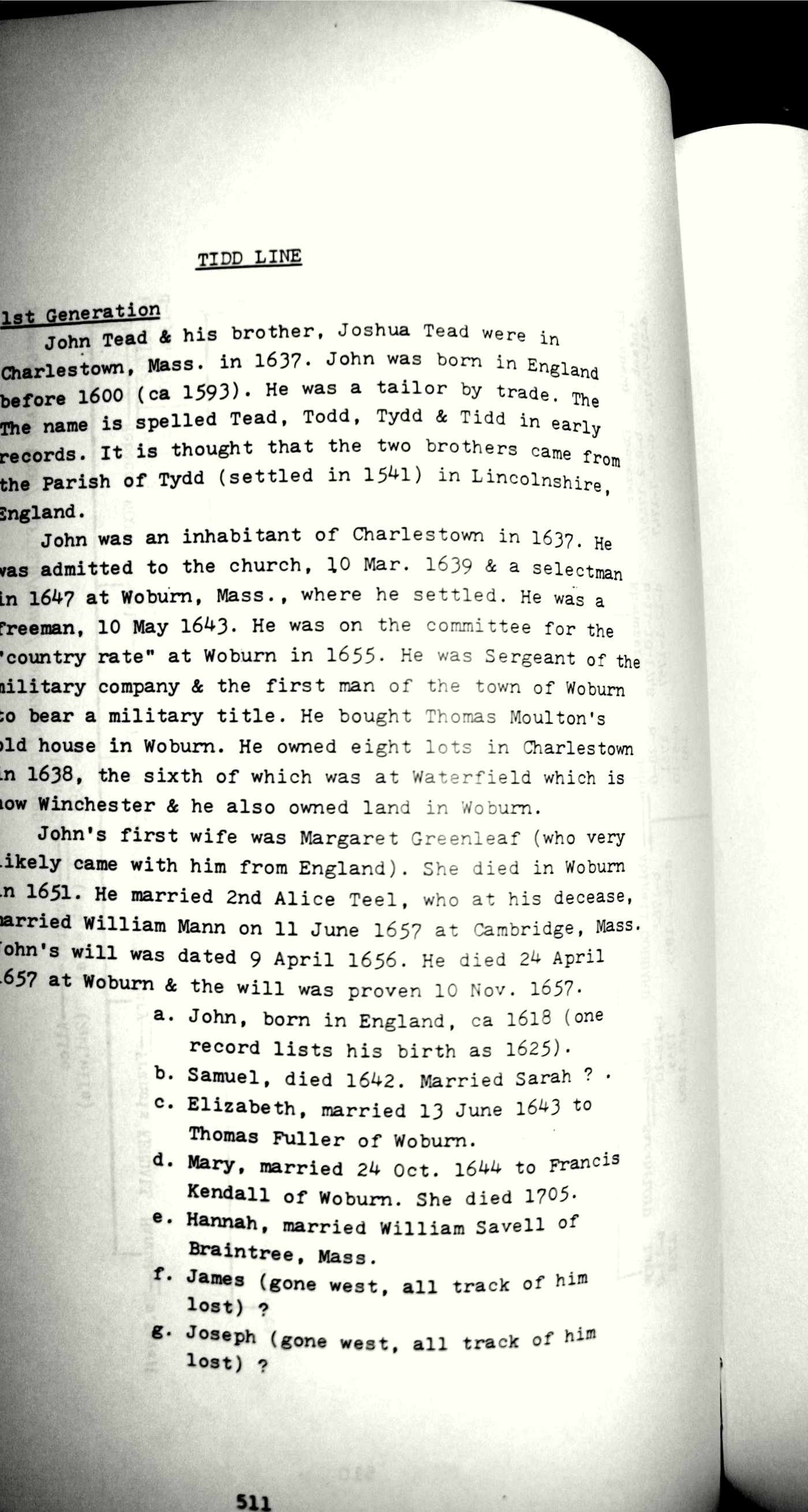
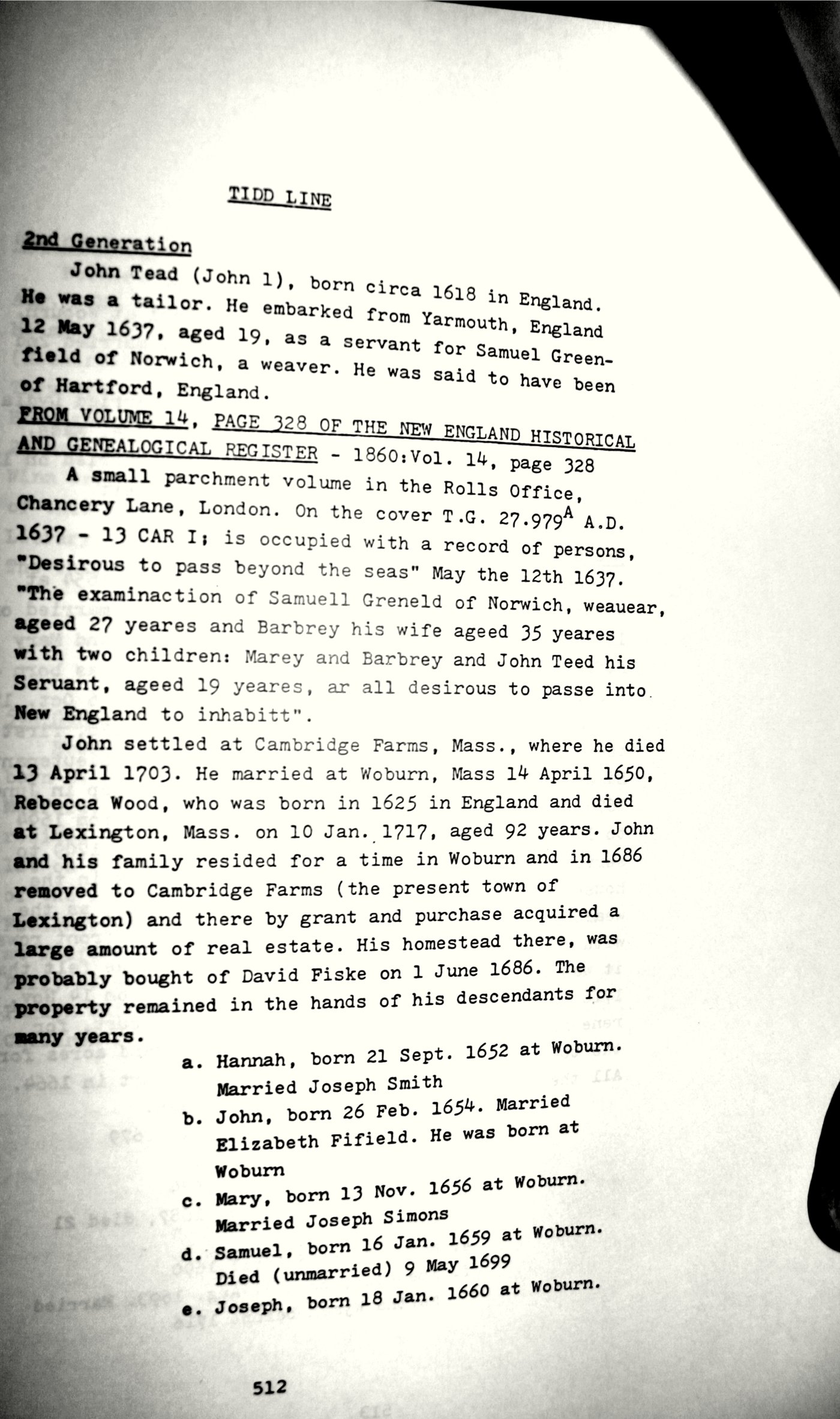
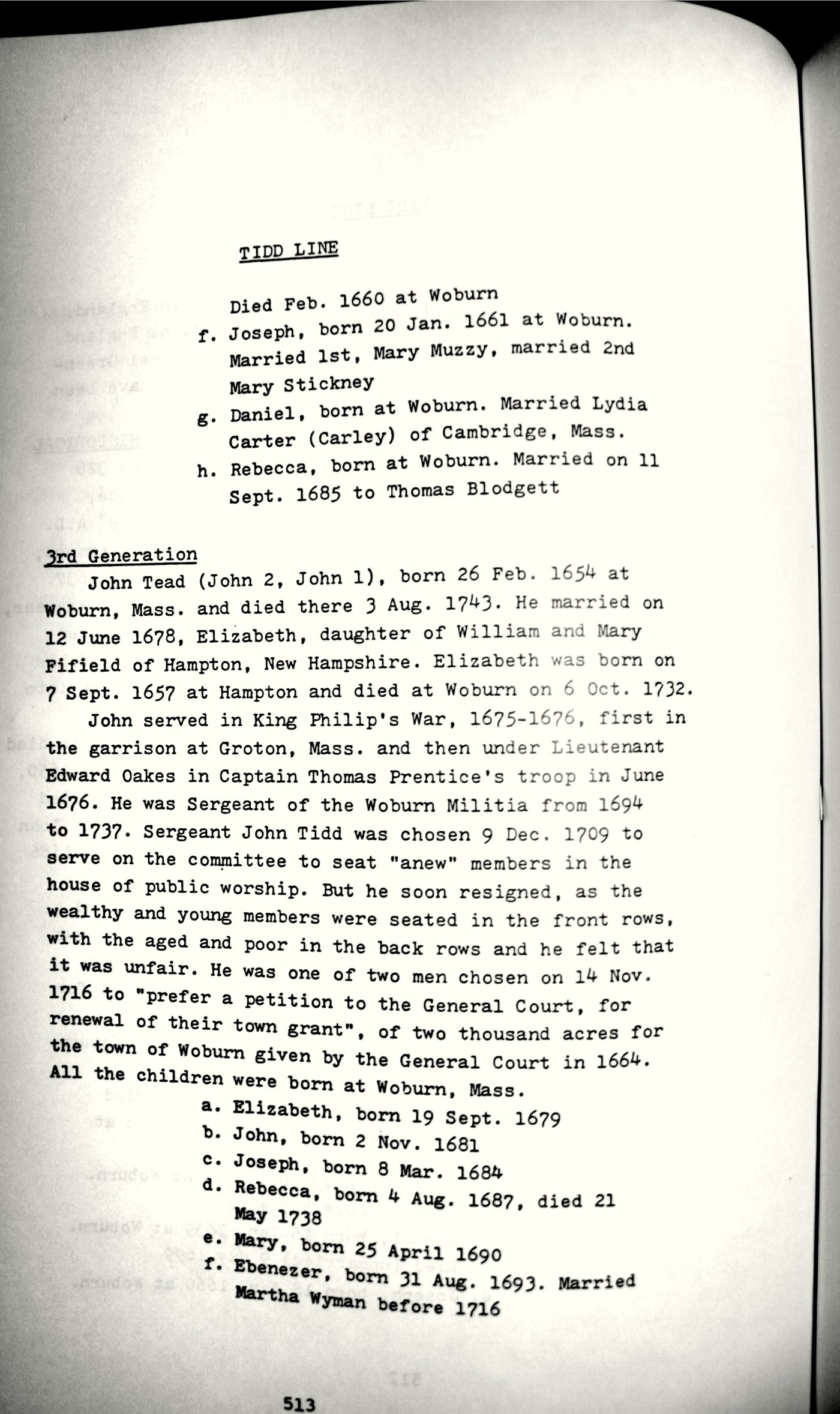
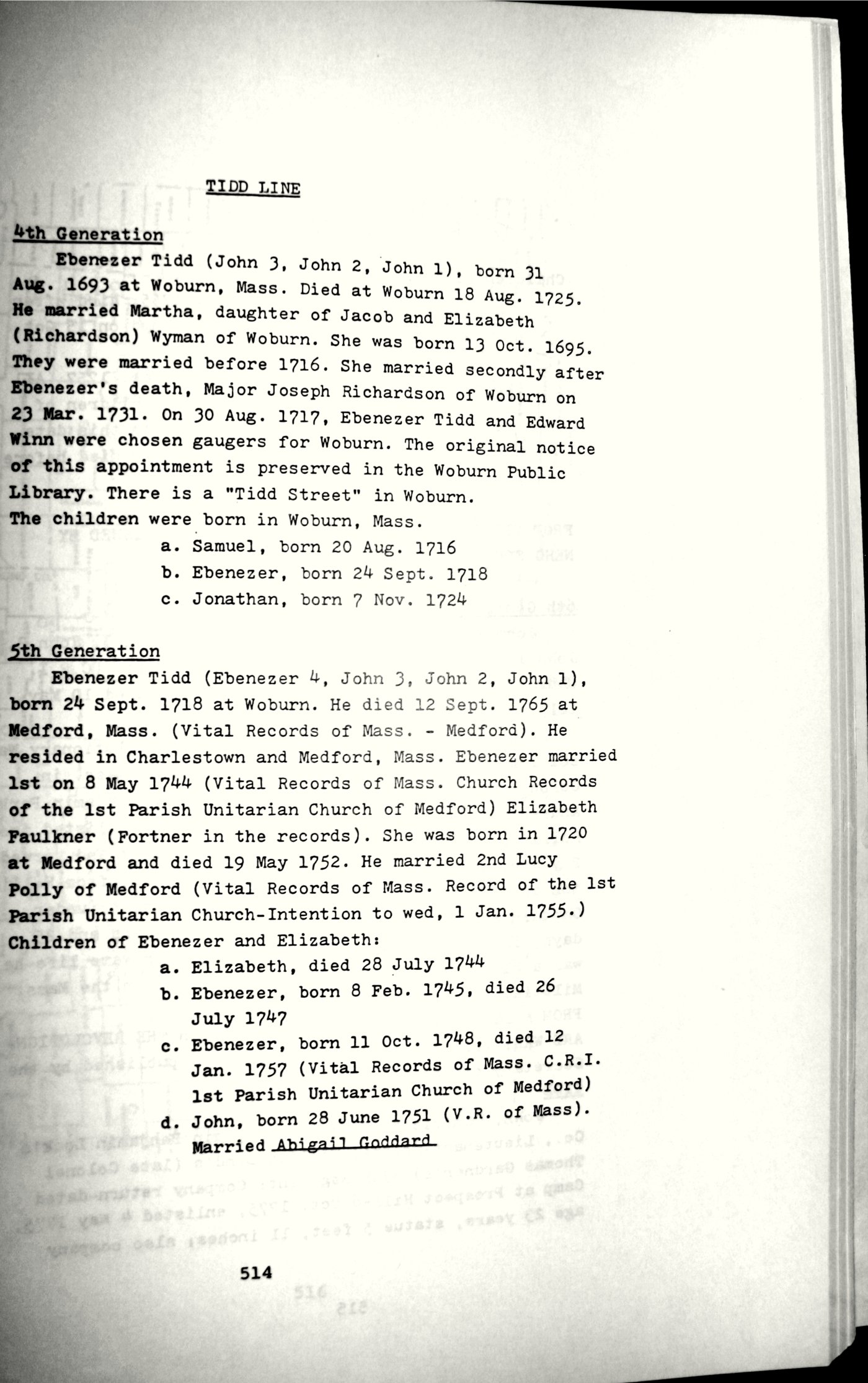
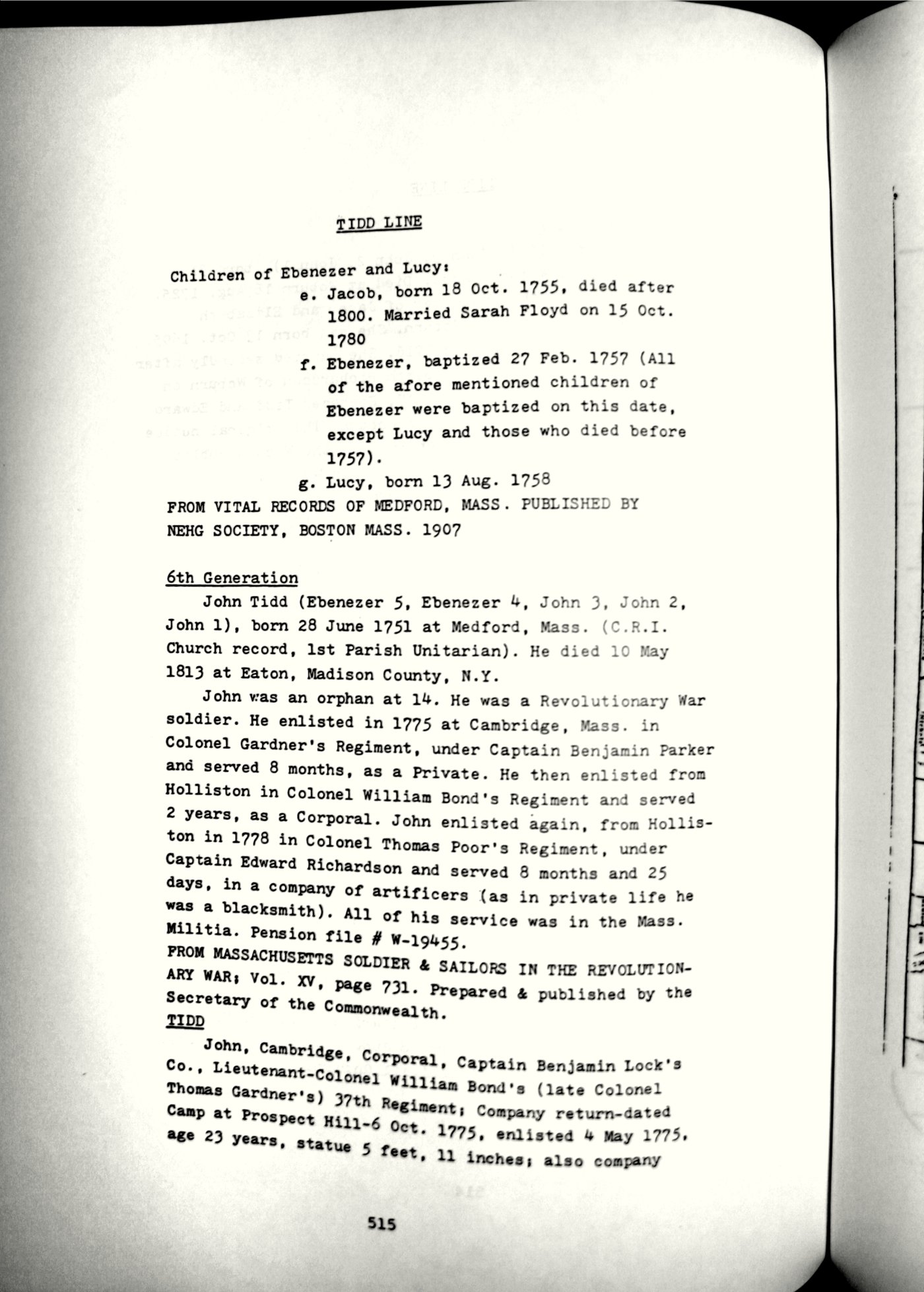
A second book from the reading room: a typed genealogy that walks the family down six generations, from Charlestown in 1637 to a Revolutionary War soldier. Turn the pages, or tap Read the text for the full large-print transcription of each page.
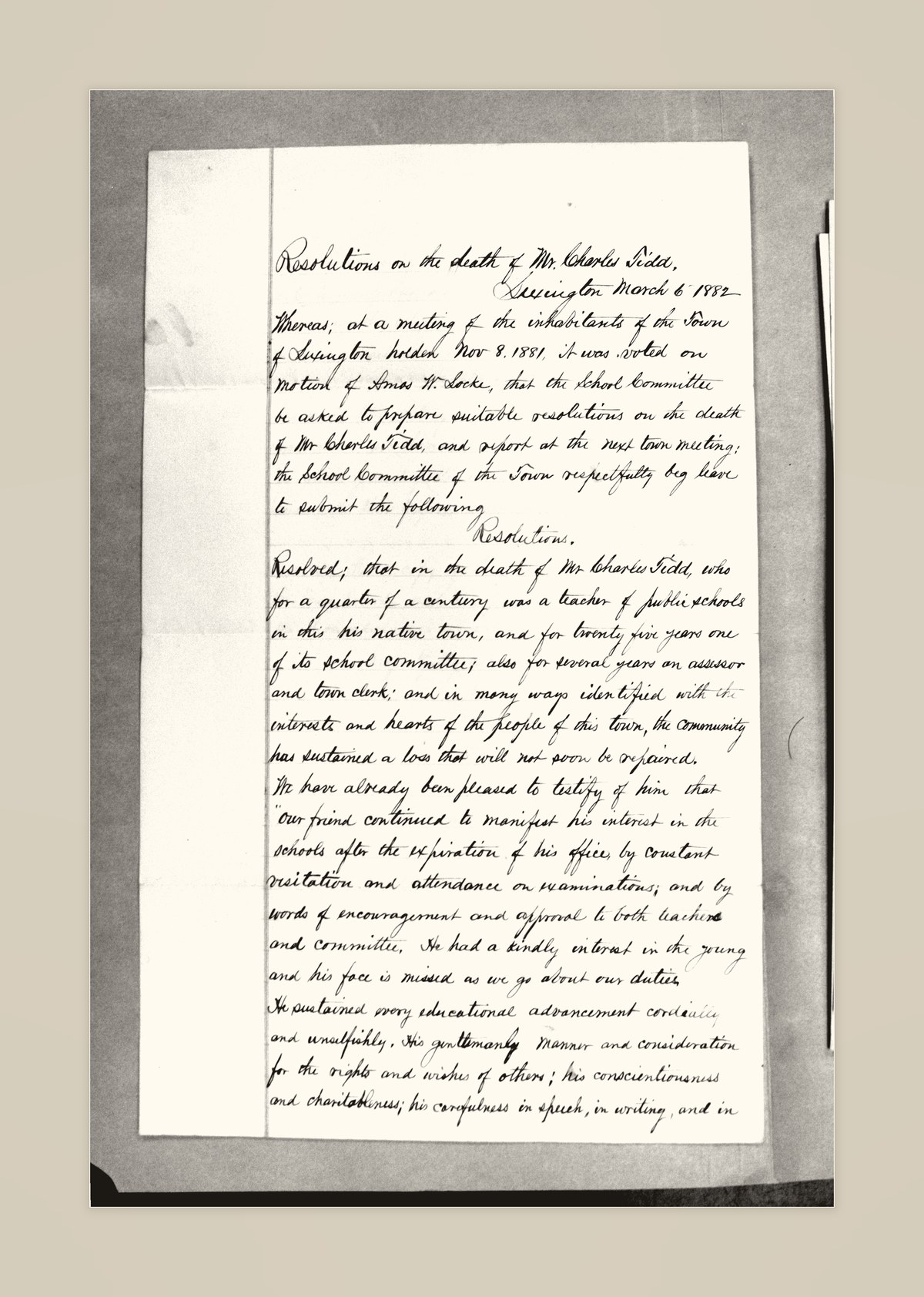
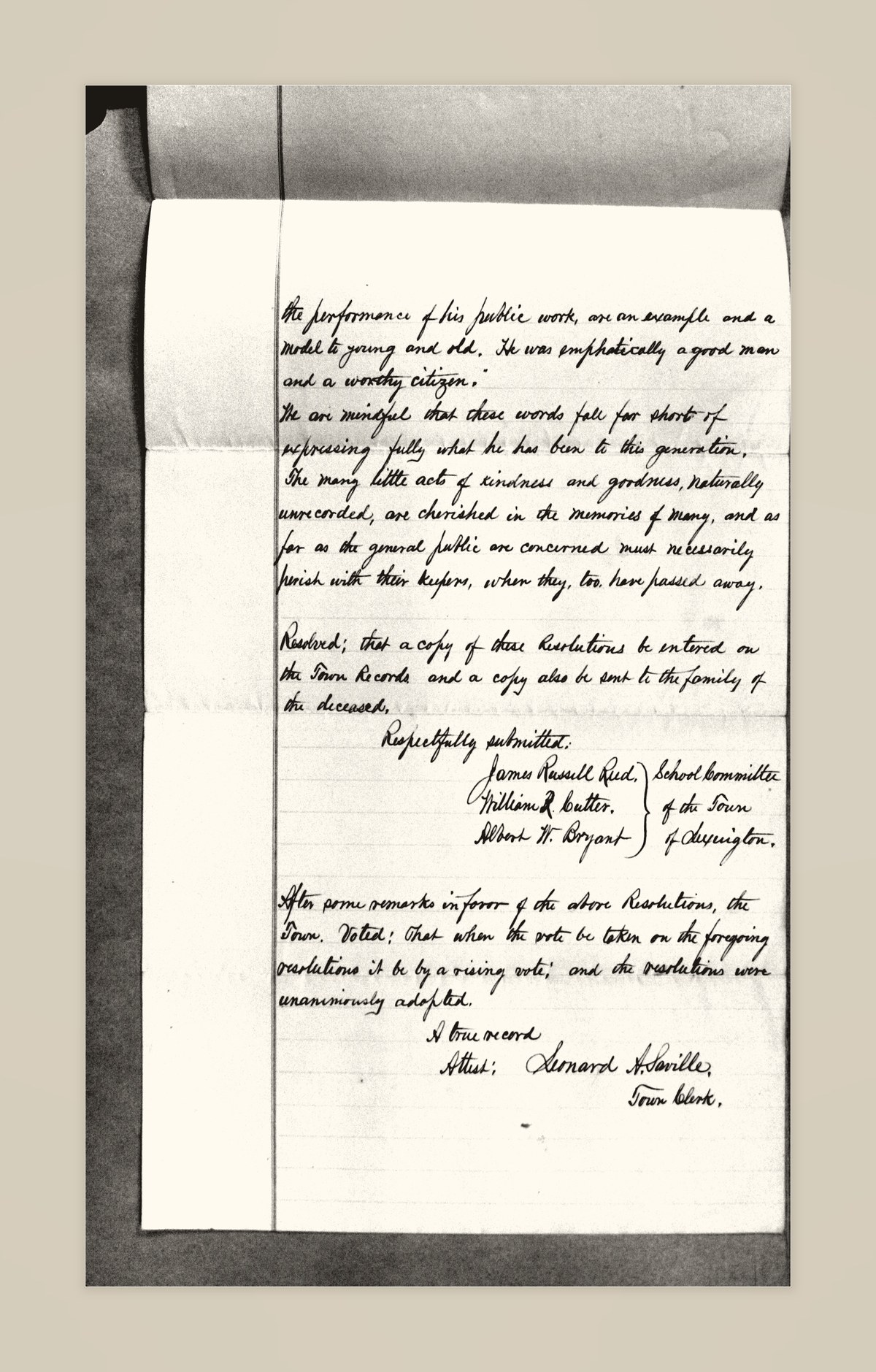
When Charles Tidd (1807–1881, aged 74), a direct ancestor of this family, died, the Town of Lexington asked its School Committee to set down, in the town record, what he had meant to the place. He had taught its public schools for a quarter of a century, and served as School Committee man, assessor and town clerk. Turn the two pages, or tap Read the text.
In 1998, at Pinehurst, Grandpa Joy (Joy Thomas Tidd, b. 1926) set down a hundred-page letter to his grandsons: a retired lawyer's honest reckoning with his hard Nebraska boyhood, and then a self-taught tour of relativity, cosmology, the Bible and the meaning of existence, with his brother's and sister's recollections and his father's farewell letters appended. It is the family's most personal document, and with his 1995 genealogy it is the research that made this site possible. Passages open below in the large-print reader.
"The author of this book is a retired lawyer lacking any training in higher mathematics or physics… While lacking formal training in the sciences, I have been intrigued with the questions of existence since my teenage years… Most of my avocational reading over the last forty years has been in neither law nor fiction but of books written for laymen in the fields of religion, philosophy, and the physical and natural sciences."
"I do not believe anyone can seriously contemplate the cosmos without contemplating religious beliefs… My own interest in religion and the cosmos arises from an inner quest for answers to the 'what' and 'why' of human existence."
"On that time scale, the 'Big Bang'… occurred at midnight, January 1. Our sun was not formed until about the 9th of September… It was not until 10:30 p.m. on New Year's Eve that the first humans appeared… Jesus was born just 4 seconds ago, and it was only one second before Guy Lombardo first played Auld Lang Syne that Columbus set sail for America. As you can see, on the cosmic time scale, we have yet to turn the first page of the book of recorded history."
"Then came the depression years, and in 1932 the banks closed… Dad did all he could to help people, much of it privately, which we learned of only after his death.… I remember food coming in by train, and he would see it was distributed to the needy… He dressed those kids in winter clothes and had coal delivered to their homes, sometimes doing it himself, so they would be warm. Remember Mrs. Decker…? She said, 'We always knew Mr. Tidd would take care of us. He wouldn't let us go hungry.' He was a good, kind, generous man."
"…This is going to be a sad shock to you I know and I ask you and our dear children to forgive me and think as kindly of me as you can. You have been a wonderful wife. I love you dearly… I am going to pass out of the picture while there is at least enough left to assure you and the children of a competence."
And Joy, sixty years on: "I want to retract what I said earlier, among other things calling his act of suicide cowardice. His love and concern are made quite apparent in a reading of the letters.… Because I am trying to be honest, I will let it stand."
"Often, when I see a little 3 or 4 year old black child in a shopping center holding on to his mother's hand, I ask myself 'How would I feel were I his father or grandfather knowing what he has to face growing up in our society?' The answer is, 'I would be consumed with rage at the injustice of it.'"
Written a century and a half after Rebecca Tidd's letters under the emblem "Am I Not a Man and a Brother?" The conviction descended with the name.
"Snowbound brings back the memories of family ties and Nebraska blizzards and, more recently, of a Virginia storm of some 20 years ago in which your dad and one of his friends had to dig our house out of a three-foot-deep snowdrift.… After surviving a blizzard, they really did have something to feel good about!"
Held by the family as a Word document; the "Lyman Years" and "War Years" chapters promised in its table of contents are missing from the surviving copy, a recovery project for the next family historian. Key passages are tagged to the people they describe on The Line.
At the head: John Tead (c. 1593), with his first wife Margaret and second wife Alice.
Beneath them the generations branch out with birth and death dates: Rebecca Wood (b. 1618, d. 1651), Samuel, Sarah, Elizabeth, Thomas Fuller, and Mary who married Francis Kendall; then Joseph Smith, John, Elizabeth Fifield, Mary, Samuel, Joseph and Daniel.
A third tier carries the line down through Elizabeth (1679), John (1681), Joseph (1684), Rebecca (1687), Mary (1690), Ebenezer (1693) and Martha Wyman; and a fourth through Samuel (1716), Ebenezer (1718–1765), Elizabeth Faulkner, Lucy “Polly,” and Jonathan (1724).
The chart threads the same names that appear on the Lexington headstones and in the Dawes-Gates book.
“Bedford, August the 7th, 1795.
For value received I promise to pay John Reed, or his order, the sum of Forty-Eight Dollars and Seventeen Cents in silver or gold on demand, with interest till paid, as witness my hand.
Attest: Jonas Farwell.”
“New-England Historic Genealogical Society.
Given by Winthrop Reed Kendall, LL.B., Oak Park, Illinois.
Dec. 12, 1913.”
Births. Nathan Tidd was born June the 11th, 1789. Crissa Tidd was born Oct. the 21st, 1796. Caroline E. Tidd was born May 21st, 1827.
Marriages. Nathan Tidd was married to Crissa Farwell Sept. the 7th, 1817. Lyman M. Kingman was married to Caroline E. Tidd June 20th, 1850.
Deaths. Nathan Tidd died July 30th, 1873, aged 84 years, 1 month, 18 days. Crissa Tidd died May 2, 1870, aged 73 years.
Crissa’s maiden name, Farwell, is the same family as the Jonas Farwell who witnessed the 1795 note nearby.
Company Pay Roll, “John Tidd, Private, Captain Edward Richardson’s Co. in the Regiment commanded by Col. Thomas Poor of the Massachusetts Militia in the service of the United States of America.” Roll dated Nov. 14, 177[8].
Receipt Roll, John Tidd, Corporal (Gardiner’s Regiment): “for pay received of Col. Wm. Bond, by the hand of Captain Lock, for service in the Continental Army for Nov. and Dec., 1775.” Roll dated Prospect Hill, Feb. 14, 1776.
List of non-commissioned officers and soldiers who appeared and repeated the oath required by Congress, dated Middlesex, June 20, 1775.
“Lexington, March 9, 1881. Mr Charles L. Tidd and others.
It becomes my duty to transmit to you the enclosed Resolutions passed by the Town of Lexington, in town meeting assembled, on the death of your honored father.
Permit me also to add my individual testimony as to his worth as a man, a citizen and a friend. I remain very respectfully, Leonard A. Saville.”
“Know all Men by these Presents, that I John Tidd of Lexington, in the County of Middlesex and Commonwealth of Massachusetts, Yeoman, in consideration of one hundred and ten pounds lawful money paid me by David Blanchard of Woburn… do give, grant, sell and convey unto the said David Blanchard and to his heirs and assigns for ever one certain wood lot lying in Woburn, formerly owned by Joseph Kendall, near Deacon Samuel Reed, containing eleven acres and an half by measure…”
“In witness whereof I the said John Tidd, with Elizabeth my now married wife consenting hereto and giving up her right of dower and power of thirds in the same, have hereunto set our hands and seal this twenty-ninth day of March, one thousand seven hundred and eighty-two.”
“Signed, sealed and delivered in presence of us: William Tidd, Joseph Simonds.” Acknowledged before Samuel Thompson, Justice of the Peace.
The bounds are walked from tree to tree: “…to a white oak stump with three branches growing upon it… then across said path to a black oak with a bunch on it near the ground… to a white oak stump where said way meets with the way leading from Concord to Woburn, which way we have stated four rod all along on the northerly side.”
Signed by the selectmen: Amos Marret, William Russell, Francis Bowman. “Copy of Record, examined per Andrew Bordman, Town Clerk of the Town of Cambridge.”
The record notes that a certain town way was laid out in that part of Cambridge “which is now Lexington,” a reminder that Lexington began as Cambridge Farms.
“Lexington, August 28th, 1798. Received of John Tidd eleven dollars and fifty cents, in full of all demands or accounts between him and me to the present time.”
“Received by me, her × mark, Polly Farrar. Attest: John Tidd, Junr.”
Polly Farrar signs with an X between her names, the mark of someone who never learned to write. The “John Tidd, Junr” who attests is the son, John Tidd (1779–1842), the next rung of the direct line.
“Joseph Tidd died September 1815, in the 66th year of his age.”
“From Death’s arrests no age is free, / My friends prepare to follow me.”
The couplet is a common New England gravestone verse, copied out here by hand as a private memorial.
“Charlestown, Oct. 11, 1806. Mr. John Tidd, bought of Joseph Reed: one chaise boot … £9-0-0; to sundries … £0-2-0; total … £9-2-0.”
“By sundries… received payment, Joseph Reed.”
A “chaise boot” was the leather apron and cover of a light two-wheeled carriage, a small window onto how the family got about.
“In this instrument, Samuel Tidd is referred to as a ‘cooper,’ so that the old family occupation was still followed. Samuel Tidd’s will is on record and reads as follows:”
“I, Samuel Tidd, of Woburn in the County of Middlesex and Commonwealth of Massachusetts, yeoman, otherwise gentleman… do make and ordain this my last will and testament. That is to say, principally and first of all I give and recommend my soul into the hands of God who gave it, and my body to be buried in a decent and Christian-like manner…”
“My will is that my daughters, viz. Phebe, Sarah, Ruth, Betty, Abigail and Mehitable, have my household furniture… and that my son Samuel pay my granddaughter Phebe, daughter of my son Benjamin Tidd, deceased, the sum of twenty shillings when she arrives to eighteen years of age.”
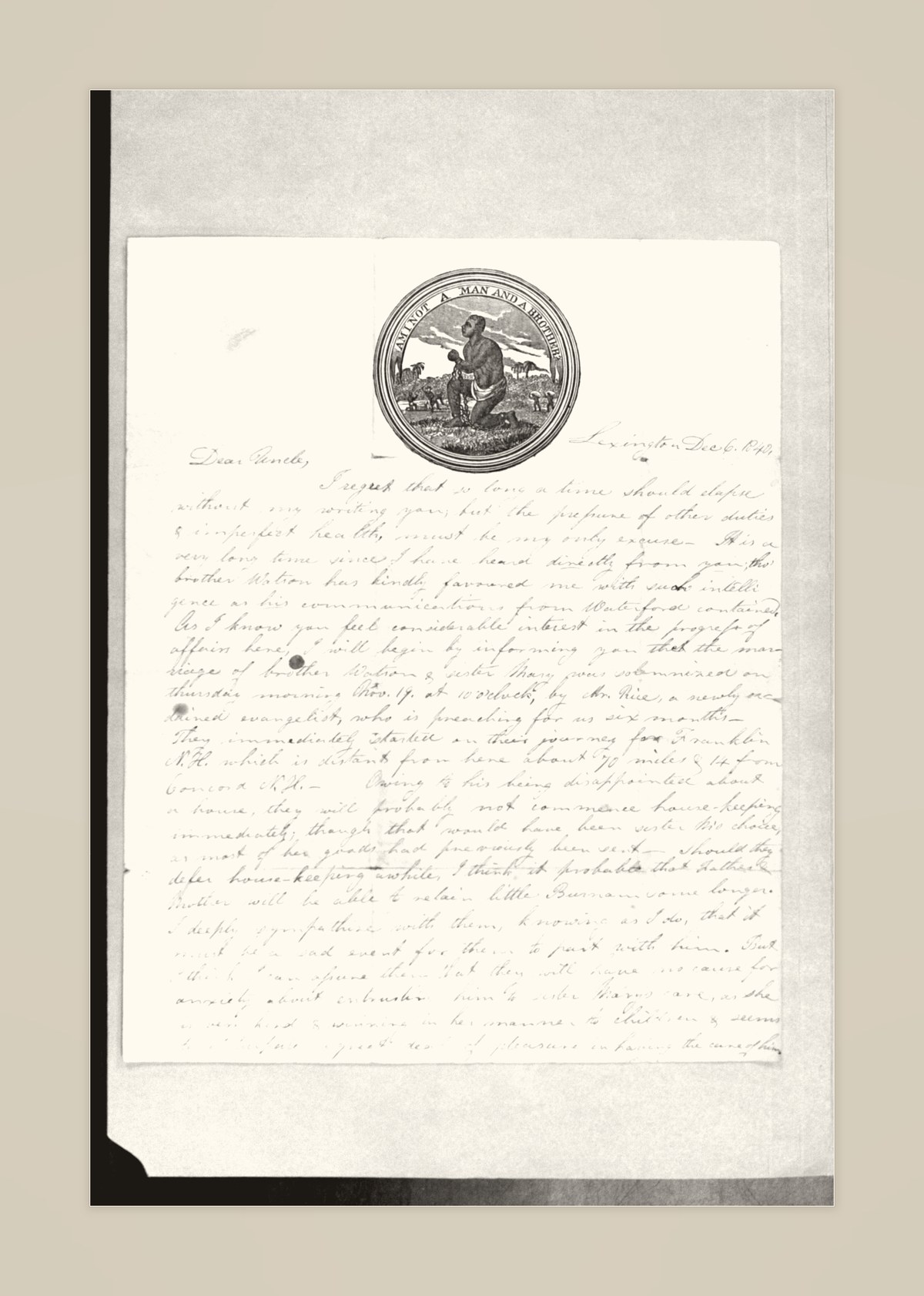
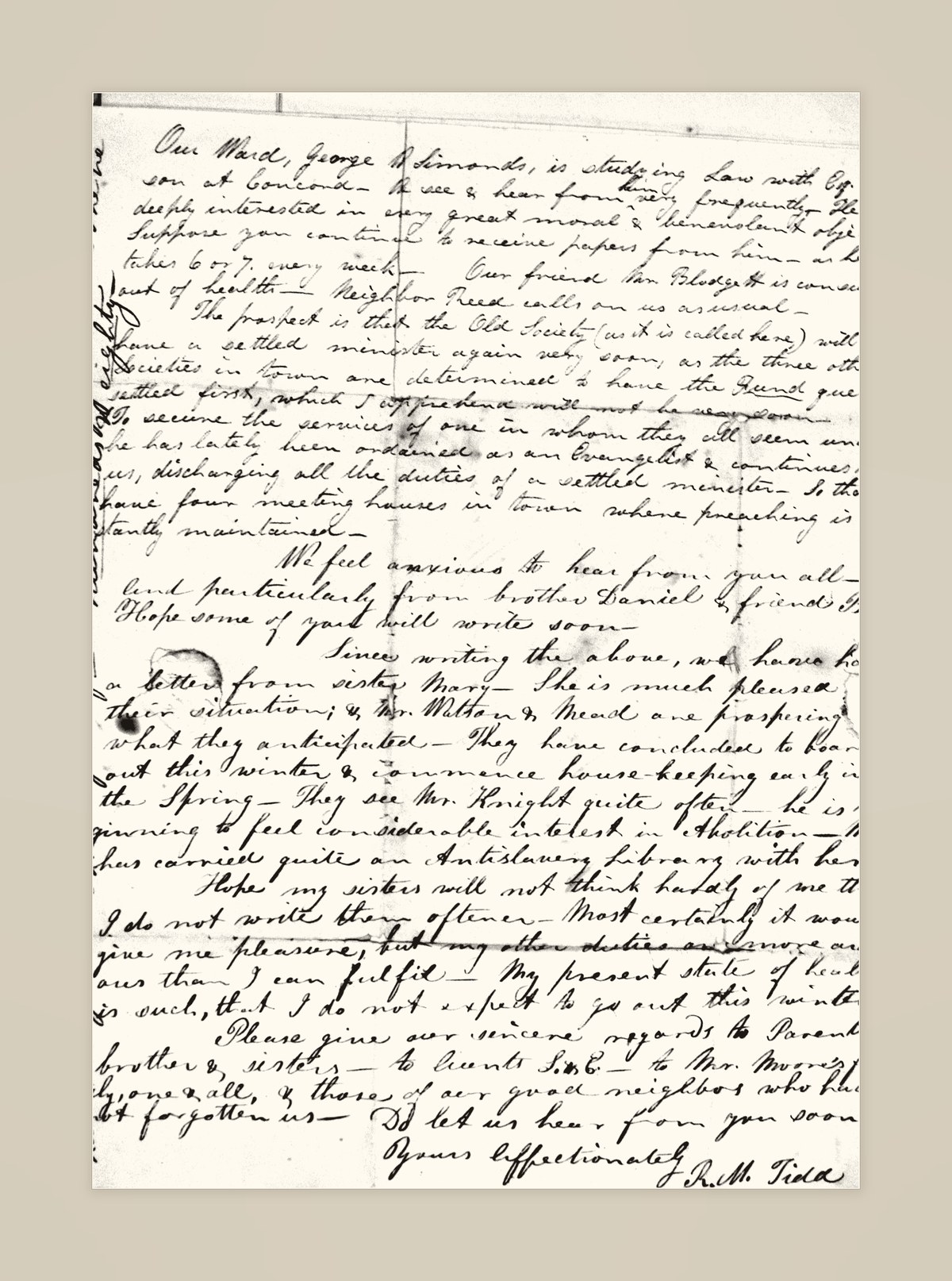
Among the papers is one that stops you cold. A family letter from Lexington, December 1840, written on stationery printed with the era’s great anti-slavery emblem: a chained, kneeling figure and the words “Am I Not a Man and a Brother?” The writer is Rebecca M. (Nourse) Tidd, wife of the Lexington schoolmaster Charles Tidd, and a direct ancestor of this family: the kids’ own five-times-great-grandmother. The news inside is ordinary, a wedding, a schoolteacher’s term, a new baby. The paper it is written on is not.
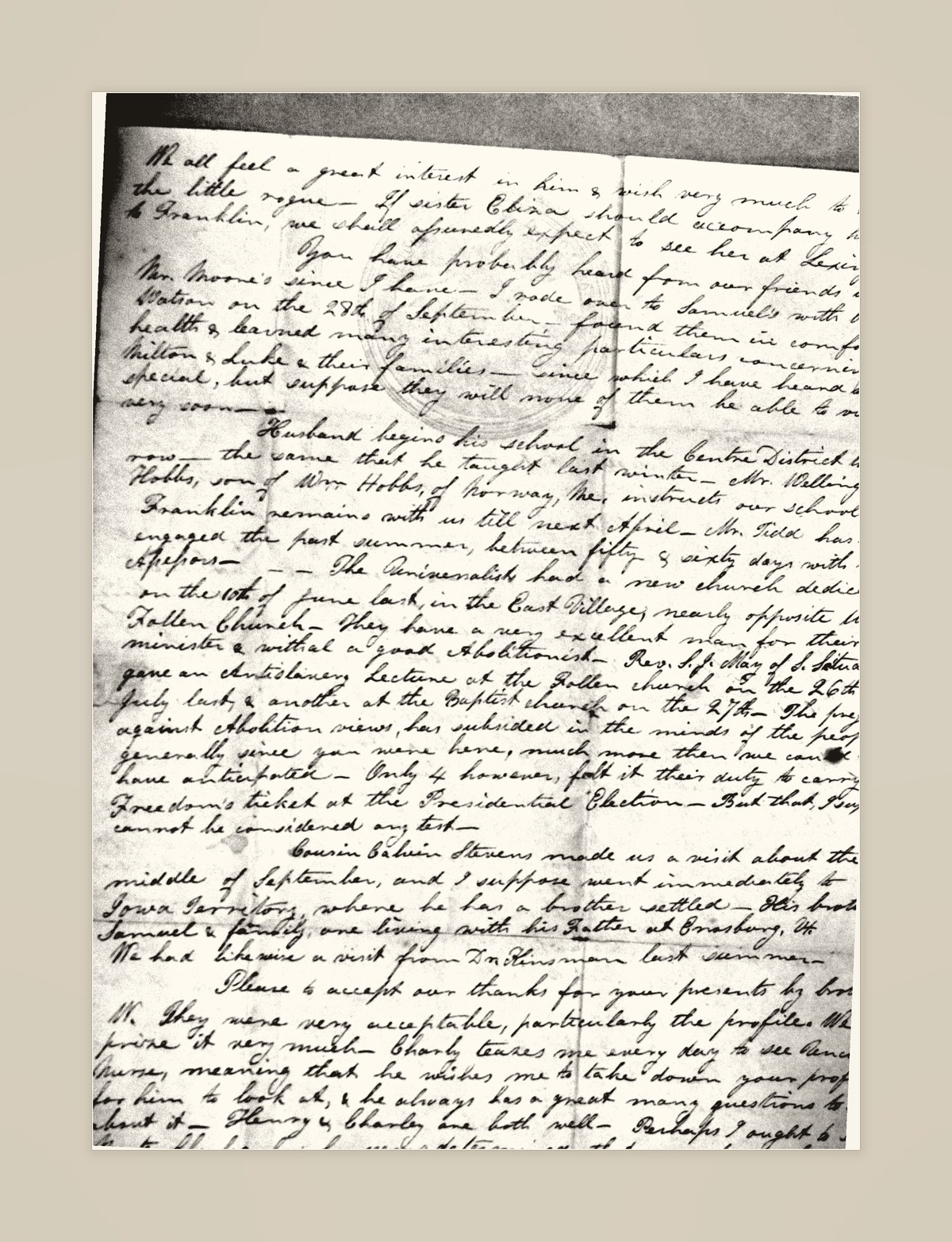
Written by R. M. Tidd, Rebecca M. (Nourse) Tidd of Waterford, Maine, to her uncle back home, on printed abolitionist letterhead. Hudson’s town genealogy confirms every name in it: her husband Charles taught the Centre District school, and “sister Mary” married David T. Watson of Franklin, N.H., on 19 November 1840, seventeen days before this letter. The emblem at the top, the kneeling enslaved man in chains, was the seal of the movement to end slavery, first cut for Josiah Wedgwood in 1787 and reproduced on paper, ribbons and tokens for half a century. To choose it for ordinary family letters was to nail your colours to the mast. Turn the pages, or tap Read the text for a large-print transcription.
The everyday news carries the movement inside it. A Lexington family in 1840 counting the four neighbours who dared vote the abolitionist Liberty ticket, turning out to hear Samuel J. May lecture against slavery, noting which relations are “beginning to feel considerable interest in Abolition,” and packing “an Antislavery Library” to carry west. And all of it set down on paper that announces the household’s convictions before a single word is read.
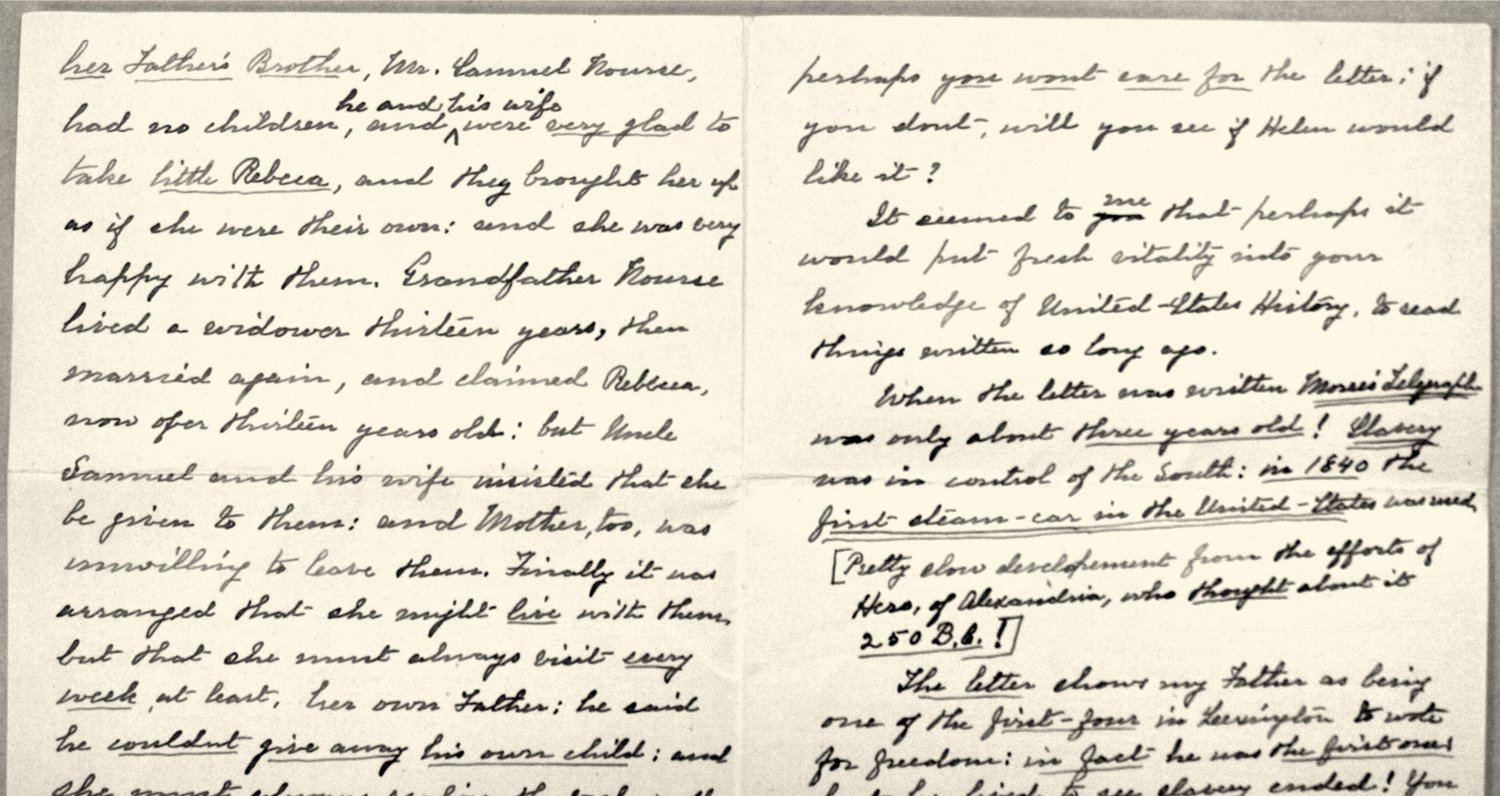
This is the letter the family long remembered. Nearly eighty years later the baby it anticipated, Aunt Esther, sent it west to her brother’s family with the words: “you see how the letter in 1840 seemed to me very full of magic power.” It has descended the direct line ever since.
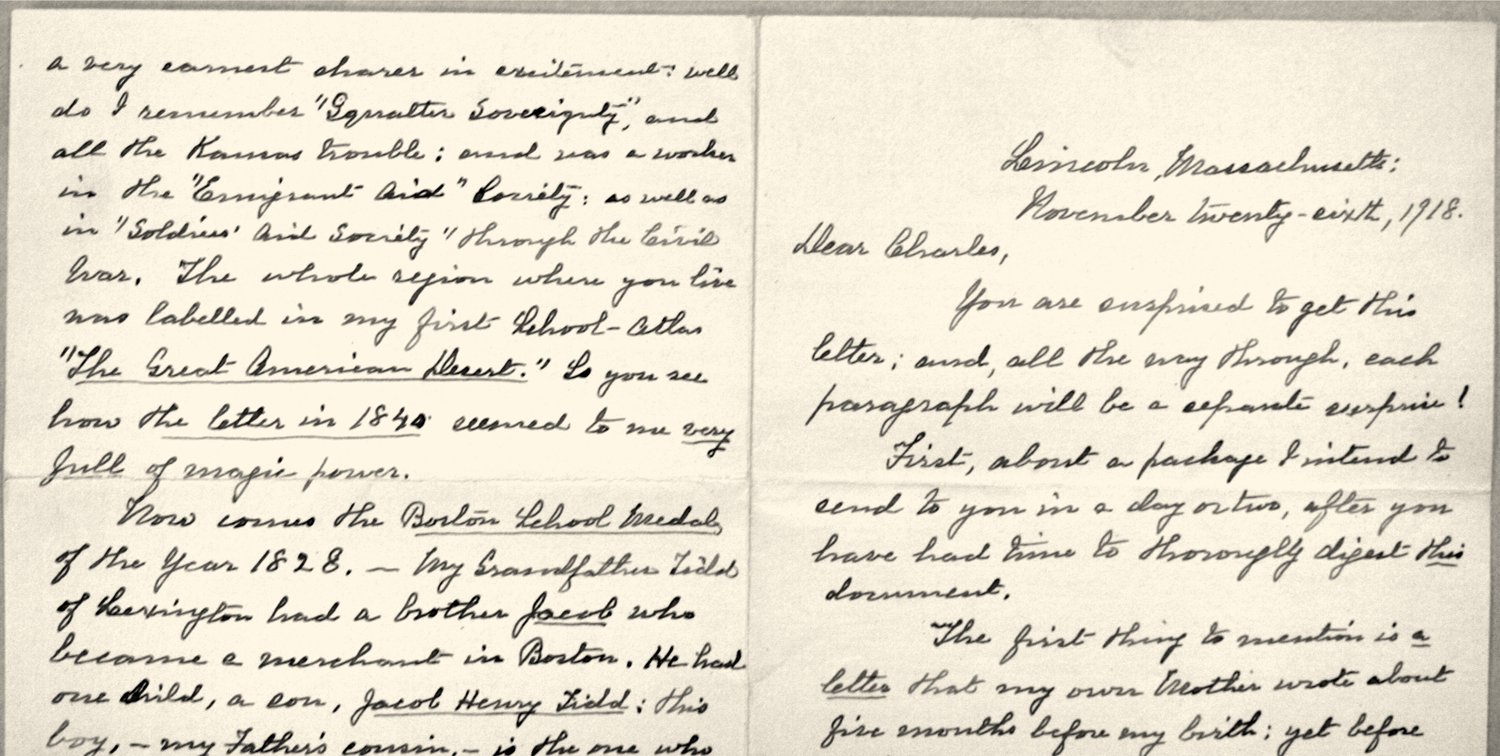
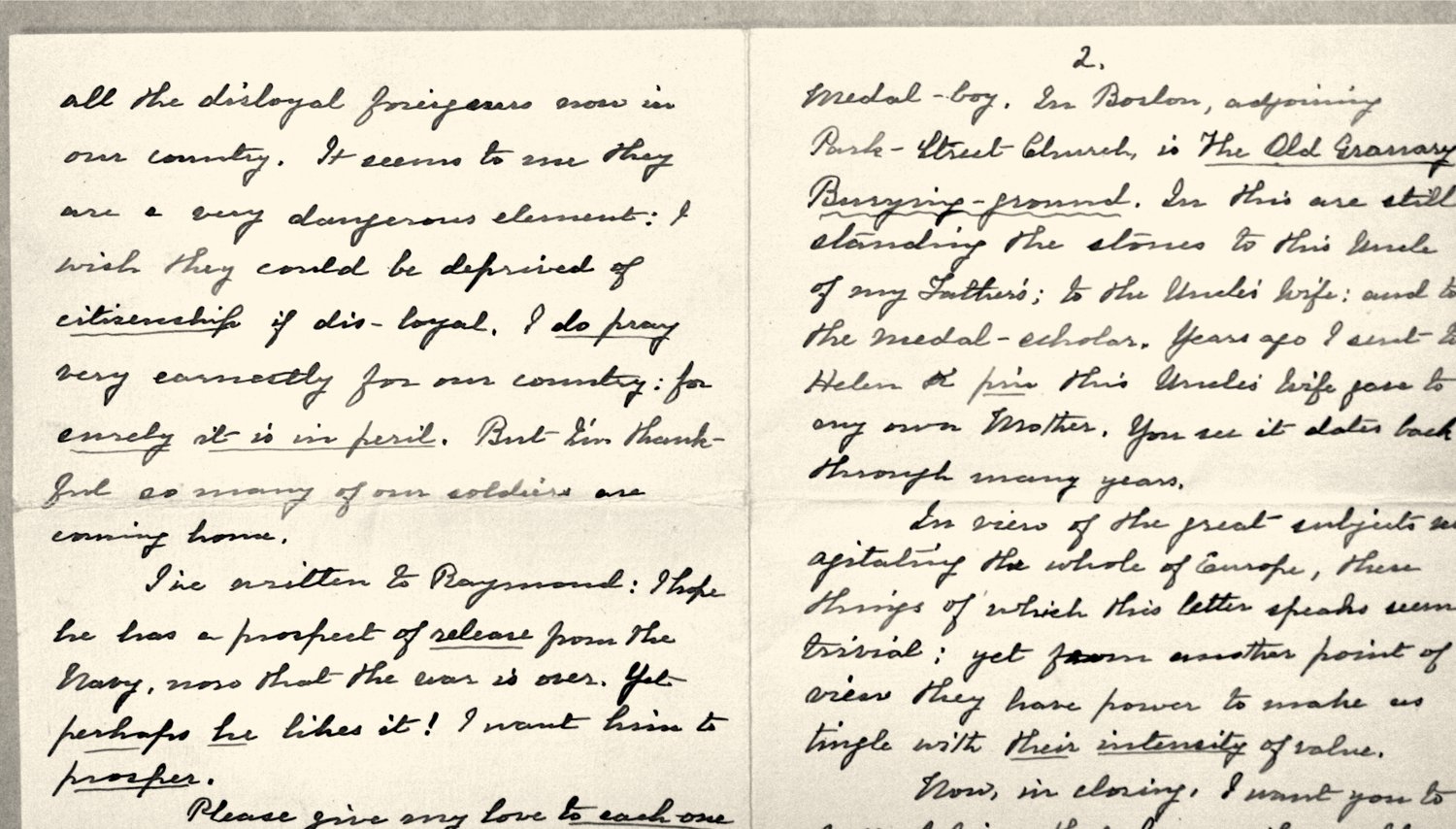
Writing in 1918 to her nephew in California, the family’s Aunt Esther, Esther Mary Tidd, born five months after the 1840 letter above, its writer’s own daughter, looks back on the years before the Civil War and puts the Tidds squarely inside the fight against slavery. She married Hayward Barrett, great-grandson of Col. James Barrett of Concord, who commanded at the Old North Bridge.
Aunt Esther (Esther Mary Tidd, m. Barrett) to C. W. Tidd · Lincoln, Mass. · 26 Nov 1918
The New England Emigrant Aid Company was no quiet charity. Backed by the era’s most famous abolitionists (Henry Ward Beecher and Wendell Phillips are both named elsewhere in these same letters), it armed and funded free-state settlers to pour into Kansas and keep it out of slavery. It was the movement that lit “Bleeding Kansas,” and the same current that carried John Brown’s men, among them the family’s own Charles Plummer Tidd.
To have a Tidd relative write, in her own hand, that she worked in the Emigrant Aid and Soldiers’ Aid societies is about as direct a line to the anti-slavery cause as a family can hope to hold.
The trip traced the family back to its first American ground, Plymouth and the coast of Massachusetts Bay, where English families like the Tidds stepped off wooden ships into a new world in the 1630s.
This is what a family history costs: a tank of gas and a few careful days.
Every document here has a home in the Sources list. Have old photos, letters or a family Bible of your own? They belong in the next edition.